Blue Ox Millworks

Greetings Fellow Travelers,

Hope the day is treating you well.  Below I have another Lincoln Highway Johnny original, a drawing of Eric Hollenbeck, owner, educator, and a bit more at Blue Ox Millworks in Eureka, California.  I have known Eric since my lumber days in the late 1970’s on the North Coast of California.

I could introduce and talk all about Eric and his work, but I think it may be better to come from him:

After the 1960s were over, a lot of “people of the 60s” moved into Northern California from the Bay Area and beyond.  Many of the folks were artisans, or just hippies who fancied themselves as some, and I have found that most of the people I have known from this area have a certain unique quality that breeds the mentality of North Coast of California. I’m not sure if it is the breaking waves on the coast or the tranquility of the Redwoods, but I do know one thing. The area breeds the artisan and the artisan creates the atmosphere of the area.

Blue Ox

My drawing honors Eric’s creation, a wooden bus he crafted himself.  He used to drive it through Rhododendron Parade in Eureka, CA.  The bus recedes at the Blue Ox Millworks today.  This drawing is a tribute to Eric, his bus creation, and all his many talents he continuously gives to the community.

Eric and Blue Ox

Above is a picture with Eric Hollenbeck and myself, Vagabond Road Artist Lincoln Highway Johnny.  Eric is holding the drawing above, which couldn’t quite stand up to the rare North Coast sunlight. Until next time, Fellow Travelers.

From the Road,

Lincoln Highway Johnny

If you would like to learn more about Eric and his work and his company, please visit Blue Ox Millworks – Eureka, CA.
Boone County Historical Center

collapse 2

Hello fellow travellers,

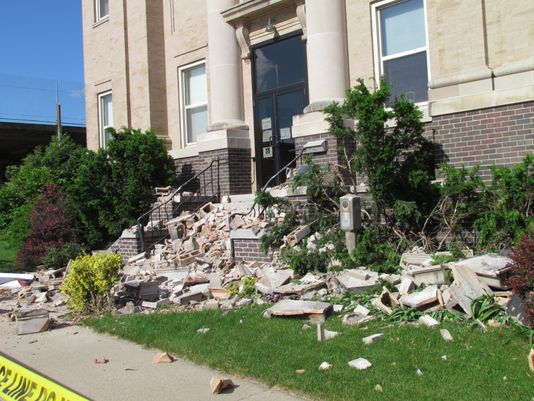
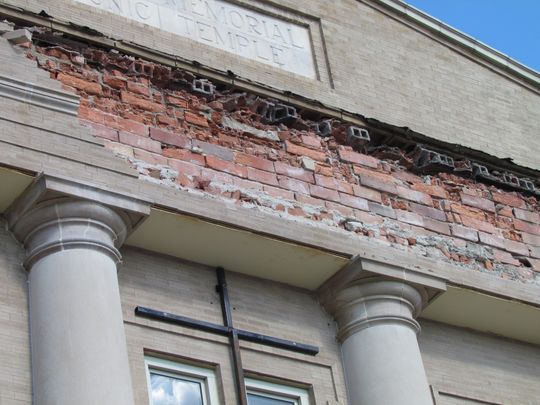
A couple days ago, on May 29th, a small tragedy occurred.  The fascade of the Boone County Historical Center collapsed, as was predicted by contractors for some time before.  The building was built in 1907 and was scheduled for masonry work mid-June, but apparently the rough Iowa winter was a bit too much for the 109 year old building.

Collapse 1

Thankfully no one was injured in the collapse, but one of our beloved relics was a casualty.  Sitting in front of the Center was an original Lincoln Highway marker, as you can see in the photo above.  The front right corner has been chipped off among the other destruction.

This particular marker was found by a good ol’ friend of the road, Ty Cassetti, just north of Boone.  Just like most of the relics, it was a buried treasure, lost in the past.  Once rescued, it was donated to the Boone County Historical Society to mark the Lincoln Highway’s heritage, as it runs through Boone.

Now, the Executive Director of the Historical Society has confirmed that the marker will be repaired along with the building, but it does leave us to question a few things. How do we protect our relics from the wear-and-tear that come with the territory in this here great nation of ours?  How do we get young people nowadays to sit up and pay attention to what’s going on around them?  All I know for sure is that we have to keep on going down this wide road.

From the Road,

Lincoln Highway Johnny

If you are interested in donating toward the rebuild of the Boone County Historical Center, please visit Boone History Center Urgent Relief.

Iowa Lincoln Highway Artist In Residence

Greetings fellow travelers.  You have all seen my Hot Rod Art style, but I wanted to give you a taste of something a little different.  As the Artist-in-Residence for the Iowa Lincoln Highway Association, I have the pleasure of creating drawings of historical sites along the landscape of the Iowa Lincoln Highway.  Most all of these drawings are taken from the early days of the Lincoln Highway.

Now think back with me to what folks experienced driving back around 1913.  These folks drove the Model-T Ford, a novelty to the common man, as was the new idea of a road trip.  The road trip caught on as a new pass-time across the nation as more people left their homes to experience new sights.  Unfortunately, the road system was not ready for this new trend and was better for the horse and buggy, not the automobile.  Long distance automobile travel was something new, as before, most had been done on the railroad lines.

Youngville Station

Youngville Station was a one-stop. A one-stop was a combination diner, hotel, and gas station all in one. The original site of the Youngville Station sits several miles west of Cedar Rapids, Iowa.  Youngville offered tourist cabins for rest at $1 per night and a cafe for eating, if you could afford a home cooked meal. If not, the cabins also provided a campsite for your dining needs. It also offered a mechanic on duty and two, state-of-the-art, visible gas pumps.

Places like Youngville usually grew up around the crossroads, spread just far enough apart so that they would bring commerce to each station and not compete with one another.

Today this site is a restored interpretive site for the Lincoln Highway in Iowa.  If you happen by Cedar Rapids, continue on and take in the wonderful history of the Youngville Station and maybe taste a little of the life folks lived many years ago.