Another One in the Books

Greetings Fellow Travelers,

Just a few weeks ago, the Iowa Lincoln Highway Association, for which, as you all know, I am the Artist-in-Residence, hosted another successful national conference in Denison, Iowa.  This is the third time we have had the honor of hosting this conference here in the state I call home.

The first national conference we hosted was in 1994 in Ames, Iowa. The organization was a young thing, with this being the second ever national Lincoln Highway Association conference.  Despite our early fears, the conference was a roaring success and set the stage for the many national conferences to come.

The conferences rotate through the 13 states of the Highway every year. As the years went by, we in Iowa had our second chance to hold the conference ten years later in 2004. This conference, lovingly called “Out of the Mud,” was hosted in Cedar Rapids, at Coe College.   We not only pulled “out of the mud,” we roared out and held yet another successful event.

This now brings our journey up to today. In the late days of June, we had our third national conference. This time around, we chose to host the conference on the western side of the state, in the town of Denison in Crawford County. Now this county holds a special place in my own story, as if you recall from one of my earlier tales, my grandpa and many more came from Crawford County.

During the conference, we visited many local haunts along the road, including a theater named after a little known lady, Ms. Donna Reed.  Here we enjoyed some old shows and spent a little time out of the heat.  As I stepped back out into the light, I was spotted by Mr. Gordon Wolf of the Denison Review. As I recounted some of my journeys along the open road, Mr. Wolf transcribed them for you to read below:

“Denison has been host to a number of Lincoln Highway Association (LHA) members this week who are in town for the national conference. For some of the visitors, the stay in Denison is akin to a homecoming. Their roots are planted in the historic coast-to-coast highway and are also tapped into the community…LHJ 1

…John Fitzsimmons is a great storyteller. A founding LHA member when he was 32, John is from Boone, via Eureka, California. He grew up in Placerville, California, which is also on the Lincoln Highway.

As the artist in residence for the LHA, he is known as “Lincoln Highway Johnny.” He creates works of art about the Lincoln Highway, all for viewing, not for sale. A display of his work was at the Boulders Conference Center for this week’s national conference.


Another strong connection with the route is that John’s grandfather, Pat Fitzsimmons, helped build the Lincoln Highway.

“Back in 1992, everyone was excited about starting the Lincoln Highway Association,” he said. “But we had to find out where it was.”

The location of parts of the original route, dedicated on October 31, 1913, by the original Lincoln Highway Association, was unknown.

One of John’s jobs was to help paint the red, white and blue Lincoln Highway logo on telephone poles along the route. “I painted over 186 of them,” he said.

John can be distinguished from his fellow LHA members by the overalls and hat he wears, and the Lincoln Highway logos he painted on the toes of his shoes. He told how that came about.


He and a partner were painting the highway logo on telephone poles in Boone County in 1992. He was standing 10 feet up on a ladder, and a swirling wind was blowing the paint in circles. “I looked and had more paint on myself than on the pole,” he said.

LHJ shoes

“Then I looked down and saw there wasn’t a drop of paint on my shoes. So I said I would train the paint to make an “L” on my shoes.”


Like others, John has a connection not only with the Lincoln Highway but with Denison and Crawford County. He said his father, Glenn Fitzsimmons, and mother, Rosemary (Segebart), grew up in Vail and knew the Mullenger family – Reed’s family.

He said his aunt Beulah Davis worked for Heidi Mullenger, Reed’s sister, and his mother knew Reed’s brother.


His mother and father moved to California in 1953. His father died three years ago at age 89. His mother is 82 and lives in Eureka.

This week, John called his mother and said, “Guess where I am. At Cronk’s.”

In her youth, his mother often stopped at Cronk’s after roller skating outings. “She said they had the best burgers,” said John. In addition, his mother’s cousin worked at Cronk’s.

For John the association is not only about preserving the history of the historic route but is also about the people. “I like attending the conference because I see people I don’t get to see all the time” said John.

But he can’t attend every national conference. He last attended one in 2013 in Kearney, Nebraska. He wanted to but was unable to attend last year’s conference in Gettysburg, Pennsylvania; he is a civil war reenactor.

“Every year we are losing members and are losing fine workers,” John said. “I want to see them.


“Everybody loves the road and the history,” he added.


“There’s something about the Lincoln Highway, but it’s not just about the concrete. It’s about what’s along the highway – the buildings and the heritage.”

To read more of about the conference as told by Mr. Gordon Wolf, head on over to Denison Lincoln Highway Conference.

As I told Mr. Wolf, the best part of these conferences is seeing my long time fellow travelers over the years. However, as with most things in this life, the best is followed by the worst, as we miss those who have journeyed along the path we all eventually must follow.

If you find yourself heading east along the road next year, stop by New Jersey, where the 2018 national conference will be hosted.

From the Open Road,

Lincoln Highway Johnny


Torque Fest 2017

Greetings Fellow Travelers,

The open road has been a bumpy one of late, which delayed some of my travels.  But I have returned and would like to talk about an “Alternative Style” car show I visited over the last weekend.

Near the Mississippi River in the Eastern Iowa town of Dubuque, Torque Fest happens every year.  I have been attending this event every year since its inception, where it started in Farley, IA and moved around until it landed finally in Dubuque.  Torque Fest is a celebration of the early creation of the American Hot Rod and all the culture that comes with it. While traversing the grounds, Bettys are plenty with rock-a-billy setting the soundtrack to the day.  The word of event is No-Billet, meaning no fancy bells and whistles.

john wells touqe festMost of the proceeds of the event go to a medical fund called Helping Hannah, who is the daughter of the founder, Mr. John Wells.  Mr. Wells, the featured man in my drawing today, founded this fest.  When I first met him, he was a purveyor of classic car films, using those funds to help his daughter.  Now he has graduated to hosting Torque Fest once a year and Iron Invasion, a car show much the same as this event, in Woolstock, IL.
This show has a flavor for all tastes, with old time races ranging from automobiles to motorcycles to chain races, to a swap meet where you can find treasures from a bygone era.  Every year in the early days of May, Torque Fest roars and rocks into Iowa, so if you should ever find yourself on the ol’ Mississippi during that time of the year, stop by and find out what this celebration of the past can give to you.

So thank you, Mr. John Wells for another successful celebration.  The cars and the Bettys were a sight for sore eyes, with the weather and the soundtrack setting the atmosphere needed to celebrate the contraptions inspired by the past.

From the Open Road,

Lincoln Highway Johnny

To learn more about Torque Fest, visit Vintage Torque Fest.


Indian Scout

Greetings Fellow Travelers,

By now we know I am a fan of things on four wheels, but I have been known to cut down to just two.  I like anything of the bygone era, especially when related to transportation.

Today, I bring you a picture of a Native American who was a horse wrangler for Buffalo Bill’s Wild West show, sitting atop of an Indian motorcycle.  How do I know this?  My grandpa, who you all have met, knew him and worked with the man behind the inspiration as a wrangler as well.

Best Indian

Pat Fitzsimmons, to me, Grandpa Pat, was a shirttail relative of Buffalo Bill Cody. His sister was married to Ed Cody, Buffalo Bill’s half-brother.  Pat befriended Buffalo Bill, who asked him if he wanted to join up with the show and participate.  My Grandpa decided to help by wrangling the horses and livestock for the show.

As a young man, Grandpa traveled to many different states with the show, curious about new places and new experiences.  By this point in the story of Buffalo Bill’s Wild West Show, the show stayed in the mainland of the good ol’ USA and did not travel abroad as it once had.  My grandpa told me of a story of a Native American who worked as a fellow wrangler.  As he had a form of dwarfism, he stayed behind the scenes.  Grandpa always said the Indian’s facial features were stoic and reminded him more of a Native American Chief than some of the other Indians who were in the show. This fellow told my grandpa that he was saving his hard earned money up to buy a motorcycle, an Indian Scout.  To this, my Grandpa replied earnestly that he figured he would have one someday soon.

Several years down the road, after Grandpa had left the show, and went back to farming and ranching in Vail, IA, he took a trip to Omaha with his cattle.  During this trip, he came upon a rare sight, an Indian riding an Indian motorcycle.  The man on the motorcycle recognized Pat and pulled alongside, stating triumphantly that he had bought his Scout.  They shared the rest of the afternoon, talking of old times and enjoying a few brews.

This picture is dedicated to Grandpa’s friend and his accomplished dream of an Indian Scout motorcycle.

From the Road,

Lincoln Highway Johnny


It Runs in the Family

Greetings, one more time today, Fellow Travelers,

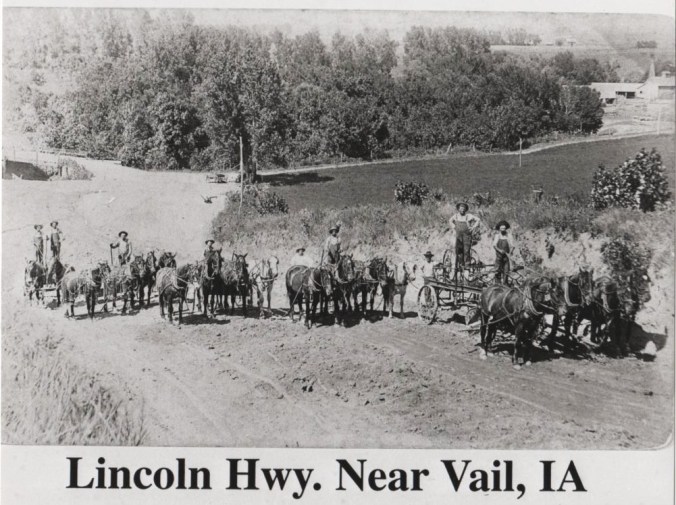
Lincoln Hwy Near Vail IA

The picture above was taken around 1913 near Vail, IA.  The fellow standing tall in the air, on top of his road grader, is none other than my own grandpa, Pat Fitzsimmons.  Pat and his crew of cousins began carving out and smoothing the roadway for the Lincoln Highway, starting their section in Missouri Valley, IA, next to the Missouri River, and working their way to Vail, IA.

Missouri Valley to Vail


Now, as the Google Maps image shows, it would take an average person about 17 hours just to walk that distance.  If you add in horses, grading the road, and the Iowa summer heat, this would have taken quite some time over the years.

As you can see, the Lincoln Highway runs in my blood from the beginnings of this great road and will continue to be reflected in my art and my narratives for many years to come.

From the Road,

Lincoln Highway Johnny


Hobart Brown and Kinetic Art

Greetings Fellow Travelers,

Hobart 2

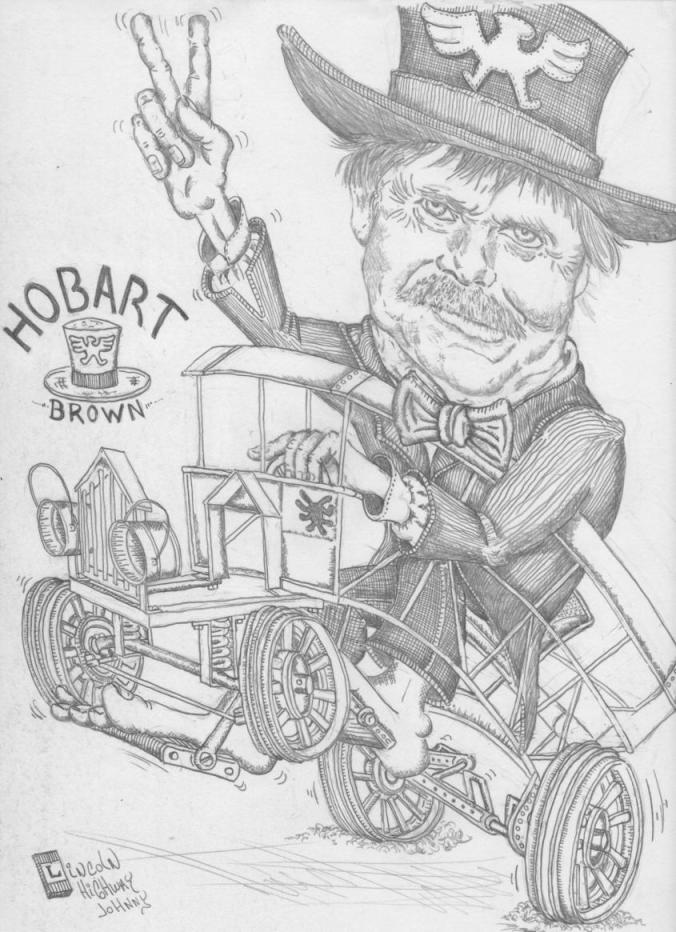
I would like to introduce you to Mr. Hobart Brown, the Glorious Founder of the Kinetic Sculpture Races in Northern California (and beyond) which, to this day, starts in Arcata, CA and ends in Ferndale, CA.

Hobart Brown

I met Hobart back in the late 70s while I was studying at the College of the Redwoods in the Art Program.  Hobart had an art gallery in Ferndale, CA, full of his specialty, metal sculptures. His biggest activity was the Kinetic Sculpture Race, which involves large moving works of art that must be hand or food operated only and must be capable of going over a variety of terrain.

I befriended Hobart and went to many of his art openings on Friday nights over the course of two years.  He was kind enough to let college students bring one piece of art to showcase on those nights. These gatherings were often similar to costume parties or masquerades.

The last time I visited with Hobart, he was plagued as many of us are by the ailments of age, with severe rheumatoid arthritis affecting him.  However, he kept in good spirits, focusing on his work to keep him going. Unfortunately, the world lost Hobart in 2007.  However, his legacy lives on around the world through the many kinetic sculpture races that occur every year and through the artwork he leaves behind.

Hobart

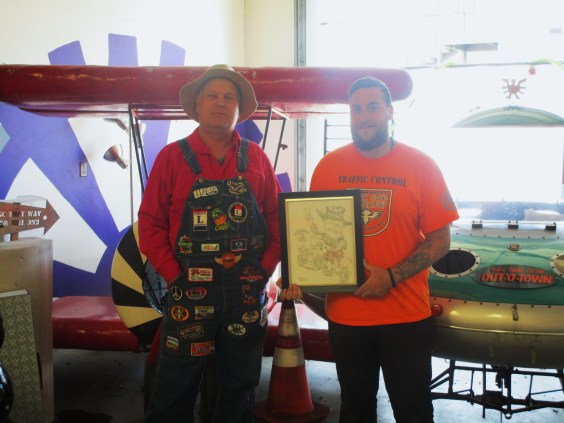
Lincoln Highway Johnny presenting his artwork to a fellow Kinetic enthusiast at the Kinetic Sculpture Museum in Eureka, CA.

The drawing above is a tribute to Hobart and his creation, the Original People Powered Bus:

From the Road,

Lincoln Highway Johnny

If you would like to learn more about the museum, please visit Kinetic Sculpture Museum, and to learn more about the races Hobart inspired, please visit Kinetic Universe and Wiki of Kinetic Races.

Blue Ox Millworks

Greetings Fellow Travelers,

Hope the day is treating you well.  Below I have another Lincoln Highway Johnny original, a drawing of Eric Hollenbeck, owner, educator, and a bit more at Blue Ox Millworks in Eureka, California.  I have known Eric since my lumber days in the late 1970’s on the North Coast of California.

I could introduce and talk all about Eric and his work, but I think it may be better to come from him:

After the 1960s were over, a lot of “people of the 60s” moved into Northern California from the Bay Area and beyond.  Many of the folks were artisans, or just hippies who fancied themselves as some, and I have found that most of the people I have known from this area have a certain unique quality that breeds the mentality of North Coast of California. I’m not sure if it is the breaking waves on the coast or the tranquility of the Redwoods, but I do know one thing. The area breeds the artisan and the artisan creates the atmosphere of the area.

Blue Ox

My drawing honors Eric’s creation, a wooden bus he crafted himself.  He used to drive it through Rhododendron Parade in Eureka, CA.  The bus recedes at the Blue Ox Millworks today.  This drawing is a tribute to Eric, his bus creation, and all his many talents he continuously gives to the community.

Eric and Blue Ox

Above is a picture with Eric Hollenbeck and myself, Vagabond Road Artist Lincoln Highway Johnny.  Eric is holding the drawing above, which couldn’t quite stand up to the rare North Coast sunlight. Until next time, Fellow Travelers.

From the Road,

Lincoln Highway Johnny

If you would like to learn more about Eric and his work and his company, please visit Blue Ox Millworks – Eureka, CA.

A Journey into a Bullet-Ridden Past

Greetings from the open road.  Today I bring to you a relic from the bygone days of the Lincoln Highway in Nevada.

Now you may be wondering, why did ol’ Johnny post some pictures of a piece of cement?  I asked myself what this was back when I found it in 1978, on a unique road trip from Eureka, CA to Green River, WY.  This trip was to reenact the route of the early day fur traders who took this route on horses, which my buddy Wayne and I did in 1978.  This journey took us three and a half weeks just going the one direction, with a little “help” from the BLM (Bureau of Land Management in Salt Lake City).

This relic was found in a low-lying area, in between Ely and Eureka, Nevada on Highway 50.  We were travelling on the north side of the current US 50, on what seemed to be an old trail or maybe a remnant of the old Lincoln Highway. We stopped for the night, made camp, and fed and watered the horses and mule. After the animals were taken care of, I journeyed out to look for dried sagebrush to make a fire for the night.

I came upon this relic on my search for fire fuel.  I showed it to my buddy, Wayne, and we were intrigued by the bullets, the lead that was seemingly shot into it.  The stone itself seemed to be a large piece of soapstone, which is not common in Nevada. I stashed the relic alongside our camp to come back and get it at a later time.

After the rendezvous in Green River, Wyoming was over, and we sold away our transportation, I returned to my hiding spot and retrieved the relic.  Now, my mission was to find out what secrets this stone held.  I talked to several old timers in that area, from Ely and Eureka, to see if they had any input to what I had in my hand.

The only story I could get was… During the early days of travel, there was a lack of one distinct thing: firewood.  If the trail needed to be marked, journeymen would use stone structures to warn people of washouts and other road hazards.  If they were to use wooden road marks, travelers would cut them apart and use them for firewood, as that is what they needed, thus endangering fellow travelers along the way.  The old timers believed that this apparent piece of a road marker was most likely broken off from a taller structure.  One old timer told me he faintly remembered stones like this lining washes next to the road.

I asked about the bullets, which seem to be .32-.36 caliber lead, and learned it may have been a few different things, from seedy characters who passed by over the years or maybe a cowboy, practicing his target shooting.  Whatever the story of the bullets really is, it truly is a neat piece of Lincoln Highway history.

From the Road,

Lincoln Highway Johnny

Boone County Historical Center

collapse 2

Hello fellow travellers,

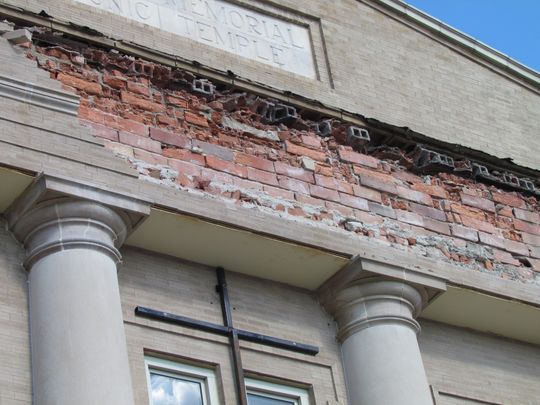
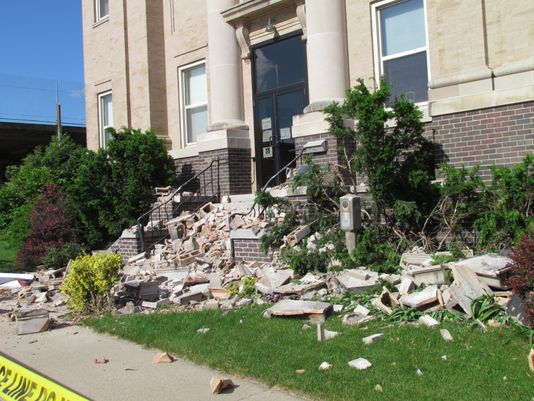
A couple days ago, on May 29th, a small tragedy occurred.  The fascade of the Boone County Historical Center collapsed, as was predicted by contractors for some time before.  The building was built in 1907 and was scheduled for masonry work mid-June, but apparently the rough Iowa winter was a bit too much for the 109 year old building.

Collapse 1

Thankfully no one was injured in the collapse, but one of our beloved relics was a casualty.  Sitting in front of the Center was an original Lincoln Highway marker, as you can see in the photo above.  The front right corner has been chipped off among the other destruction.

This particular marker was found by a good ol’ friend of the road, Ty Cassetti, just north of Boone.  Just like most of the relics, it was a buried treasure, lost in the past.  Once rescued, it was donated to the Boone County Historical Society to mark the Lincoln Highway’s heritage, as it runs through Boone.

Now, the Executive Director of the Historical Society has confirmed that the marker will be repaired along with the building, but it does leave us to question a few things. How do we protect our relics from the wear-and-tear that come with the territory in this here great nation of ours?  How do we get young people nowadays to sit up and pay attention to what’s going on around them?  All I know for sure is that we have to keep on going down this wide road.

From the Road,

Lincoln Highway Johnny

If you are interested in donating toward the rebuild of the Boone County Historical Center, please visit Boone History Center Urgent Relief.

Iowa Lincoln Highway Artist In Residence

Greetings fellow travelers.  You have all seen my Hot Rod Art style, but I wanted to give you a taste of something a little different.  As the Artist-in-Residence for the Iowa Lincoln Highway Association, I have the pleasure of creating drawings of historical sites along the landscape of the Iowa Lincoln Highway.  Most all of these drawings are taken from the early days of the Lincoln Highway.

Now think back with me to what folks experienced driving back around 1913.  These folks drove the Model-T Ford, a novelty to the common man, as was the new idea of a road trip.  The road trip caught on as a new pass-time across the nation as more people left their homes to experience new sights.  Unfortunately, the road system was not ready for this new trend and was better for the horse and buggy, not the automobile.  Long distance automobile travel was something new, as before, most had been done on the railroad lines.

Youngville Station

Youngville Station was a one-stop. A one-stop was a combination diner, hotel, and gas station all in one. The original site of the Youngville Station sits several miles west of Cedar Rapids, Iowa.  Youngville offered tourist cabins for rest at $1 per night and a cafe for eating, if you could afford a home cooked meal. If not, the cabins also provided a campsite for your dining needs. It also offered a mechanic on duty and two, state-of-the-art, visible gas pumps.

Places like Youngville usually grew up around the crossroads, spread just far enough apart so that they would bring commerce to each station and not compete with one another.

Today this site is a restored interpretive site for the Lincoln Highway in Iowa.  If you happen by Cedar Rapids, continue on and take in the wonderful history of the Youngville Station and maybe taste a little of the life folks lived many years ago.

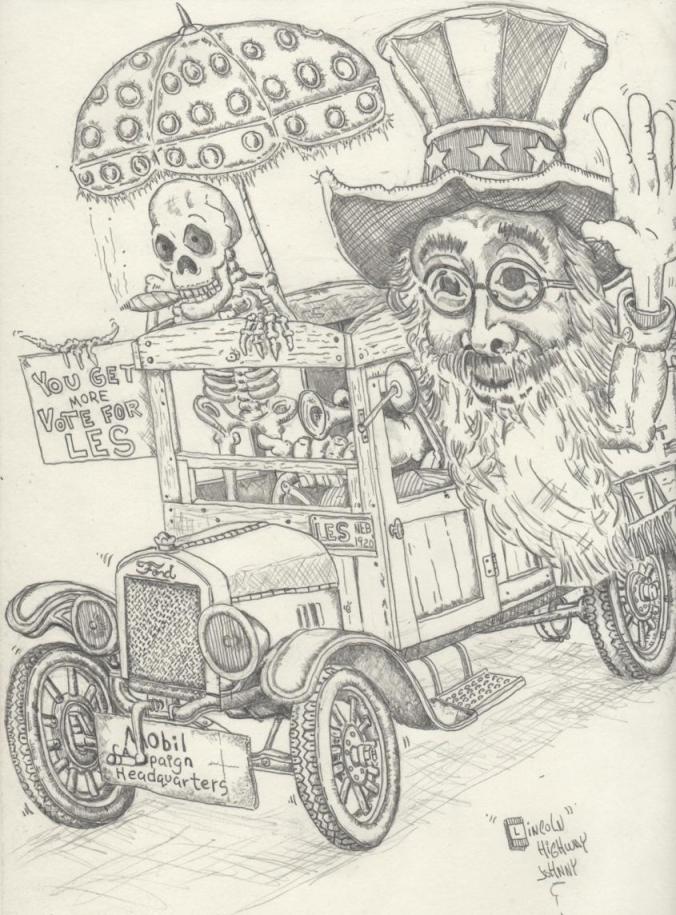
Vote for the B.E.E.R party today!

vildaWith it being the season of blowhards and wannabes contending to change America, here is the real candidate for the job!  Les Vilda, a historical educator from Wilber, Nebraska, is the candidate for the B.E.E.R, Biologically Engineered Experimental Reindeer…or whatever, party. If he is elected, he will rid this country of its worst enemy, skunked beer.

If any of you have the opportunity, check him out on YouTube or at his website, Have Donkey, Will Travel

You go, Les!  (a.k.a. Dr. Rabbi).

From the Road,

Lincoln Highway Johnny