Indian Scout

Greetings Fellow Travelers,

By now we know I am a fan of things on four wheels, but I have been known to cut down to just two.  I like anything of the bygone era, especially when related to transportation.

Today, I bring you a picture of a Native American who was a horse wrangler for Buffalo Bill’s Wild West show, sitting atop of an Indian motorcycle.  How do I know this?  My grandpa, who you all have met, knew him and worked with the man behind the inspiration as a wrangler as well.

Best Indian

Pat Fitzsimmons, to me, Grandpa Pat, was a shirttail relative of Buffalo Bill Cody. His sister was married to Ed Cody, Buffalo Bill’s half-brother.  Pat befriended Buffalo Bill, who asked him if he wanted to join up with the show and participate.  My Grandpa decided to help by wrangling the horses and livestock for the show.

As a young man, Grandpa traveled to many different states with the show, curious about new places and new experiences.  By this point in the story of Buffalo Bill’s Wild West Show, the show stayed in the mainland of the good ol’ USA and did not travel abroad as it once had.  My grandpa told me of a story of a Native American who worked as a fellow wrangler.  As he had a form of dwarfism, he stayed behind the scenes.  Grandpa always said the Indian’s facial features were stoic and reminded him more of a Native American Chief than some of the other Indians who were in the show. This fellow told my grandpa that he was saving his hard earned money up to buy a motorcycle, an Indian Scout.  To this, my Grandpa replied earnestly that he figured he would have one someday soon.

Several years down the road, after Grandpa had left the show, and went back to farming and ranching in Vail, IA, he took a trip to Omaha with his cattle.  During this trip, he came upon a rare sight, an Indian riding an Indian motorcycle.  The man on the motorcycle recognized Pat and pulled alongside, stating triumphantly that he had bought his Scout.  They shared the rest of the afternoon, talking of old times and enjoying a few brews.

This picture is dedicated to Grandpa’s friend and his accomplished dream of an Indian Scout motorcycle.

From the Road,

Lincoln Highway Johnny


Hobart Brown and Kinetic Art

Greetings Fellow Travelers,

Hobart 2

I would like to introduce you to Mr. Hobart Brown, the Glorious Founder of the Kinetic Sculpture Races in Northern California (and beyond) which, to this day, starts in Arcata, CA and ends in Ferndale, CA.

Hobart Brown

I met Hobart back in the late 70s while I was studying at the College of the Redwoods in the Art Program.  Hobart had an art gallery in Ferndale, CA, full of his specialty, metal sculptures. His biggest activity was the Kinetic Sculpture Race, which involves large moving works of art that must be hand or food operated only and must be capable of going over a variety of terrain.

I befriended Hobart and went to many of his art openings on Friday nights over the course of two years.  He was kind enough to let college students bring one piece of art to showcase on those nights. These gatherings were often similar to costume parties or masquerades.

The last time I visited with Hobart, he was plagued as many of us are by the ailments of age, with severe rheumatoid arthritis affecting him.  However, he kept in good spirits, focusing on his work to keep him going. Unfortunately, the world lost Hobart in 2007.  However, his legacy lives on around the world through the many kinetic sculpture races that occur every year and through the artwork he leaves behind.

Hobart

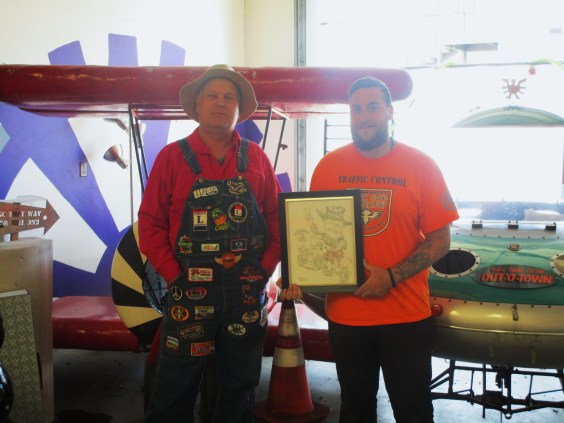
Lincoln Highway Johnny presenting his artwork to a fellow Kinetic enthusiast at the Kinetic Sculpture Museum in Eureka, CA.

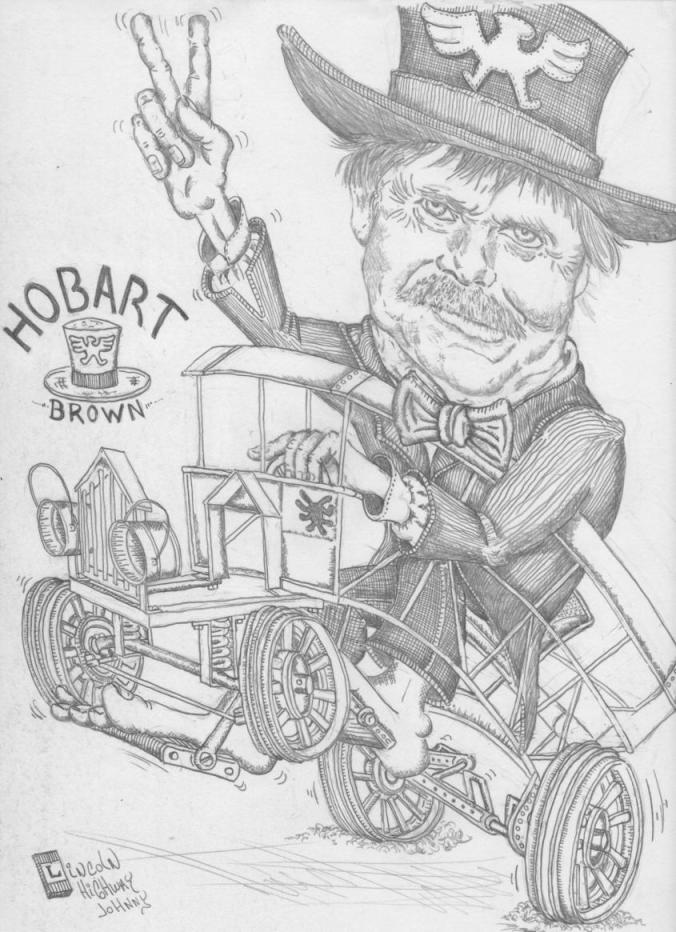
The drawing above is a tribute to Hobart and his creation, the Original People Powered Bus:

From the Road,

Lincoln Highway Johnny
If you would like to learn more about the museum, please visit Kinetic Sculpture Museum, and to learn more about the races Hobart inspired, please visit Kinetic Universe and Wiki of Kinetic Races.

Iowa Lincoln Highway Artist In Residence

Greetings fellow travelers.  You have all seen my Hot Rod Art style, but I wanted to give you a taste of something a little different.  As the Artist-in-Residence for the Iowa Lincoln Highway Association, I have the pleasure of creating drawings of historical sites along the landscape of the Iowa Lincoln Highway.  Most all of these drawings are taken from the early days of the Lincoln Highway.

Now think back with me to what folks experienced driving back around 1913.  These folks drove the Model-T Ford, a novelty to the common man, as was the new idea of a road trip.  The road trip caught on as a new pass-time across the nation as more people left their homes to experience new sights.  Unfortunately, the road system was not ready for this new trend and was better for the horse and buggy, not the automobile.  Long distance automobile travel was something new, as before, most had been done on the railroad lines.

Youngville Station

Youngville Station was a one-stop. A one-stop was a combination diner, hotel, and gas station all in one. The original site of the Youngville Station sits several miles west of Cedar Rapids, Iowa.  Youngville offered tourist cabins for rest at $1 per night and a cafe for eating, if you could afford a home cooked meal. If not, the cabins also provided a campsite for your dining needs. It also offered a mechanic on duty and two, state-of-the-art, visible gas pumps.

Places like Youngville usually grew up around the crossroads, spread just far enough apart so that they would bring commerce to each station and not compete with one another.

Today this site is a restored interpretive site for the Lincoln Highway in Iowa.  If you happen by Cedar Rapids, continue on and take in the wonderful history of the Youngville Station and maybe taste a little of the life folks lived many years ago.